Gemma 4 12B 开源:去掉多模态编码器、把图像与音频直灌进 LLM 主干,16GB 内存即可笔记本本地跑、性能接近 26B MoE
Introducing Gemma 4 12B: a unified, encoder-free multimodal model
精选评分 71
导读
Google DeepMind 发布 Gemma 4 12B,一款把 agentic 多模态智能带到笔记本的开源模型,填补面向边缘的 E4B 与更强的 26B MoE 之间的空档,也是首个支持原生音频输入的中型 Gemma。架构上的关键是无编码器:视觉用一个单次矩阵乘加位置编码与归一化的轻量嵌入模块替换掉原视觉编码器,音频则彻底移除编码器、把原始音频信号投影到与文本 token 同一维度空间,由 LLM 主干直接处理,从而降低延迟与显存。它在标准基准上逼近 26B MoE、内存占用不到一半,16GB 显存即可本地运行;以 Apache 2.0 发布、配 Multi-Token Prediction 草稿器降延迟。Gemma 4 系列下载量已破 1.5 亿。
推荐理由
用一个反直觉的无编码器设计把音频与视觉并入主干,同时给出 16GB 与逼近 26B 的量化口径,端侧多模态选型可据此直接对比。
主体与标签
Google DeepMind#模型发布#开源/仓库#多模态#端侧
正文
Gemma 4 12B is designed to bring high-performance multimodal intelligence directly to your laptop, combining mobile-first efficiency with advanced reasoning.
Director of Product Management, Google Deepmind
Product Manager, Google DeepMind

Your browser does not support the audio element.
This content is generated by Google AI. Generative AI is experimental
Today, we are introducing Gemma 4 12B, our latest model designed to bring agentic multimodal intelligence directly to laptops. Bridging the gap between our edge-friendly E4B and our more advanced 26B Mixture of Experts (MoE), Gemma 4 12B packages powerful capabilities inside a reduced memory footprint. It is also our first mid-sized model to feature native audio inputs.
Thanks to the developer community, Gemma 4 models have now crossed 150 million downloads. You’ve built everything from wearable robotic arms for physical assistance to enterprise-grade AI security . We're excited to see what you build with this latest addition.
Here’s an overview of what makes Gemma 4 12B unique:
- Novel unified architecture: No multimodal encoders. The vision and audio inputs flow directly into the LLM backbone.
- Advanced reasoning: Benchmark performance nearing our 26B model, unlocking powerful multi-step reasoning and agentic workflows.
- Laptop ready: Small enough to run locally with just 16GB of VRAM or unified memory.
- Open and accessible: Released under an Apache 2.0 license with support across the developer ecosystem.
- Drafter-ready: Gemma 4 12B comes equipped with Multi-Token Prediction (MTP) drafters to reduce latency.
Together, these features bring advanced multimodal capabilities to everyday hardware without sacrificing speed or reasoning. Let's now take a closer look at how Gemma 4 12B achieves this.
Run state-of-the-art agents locally
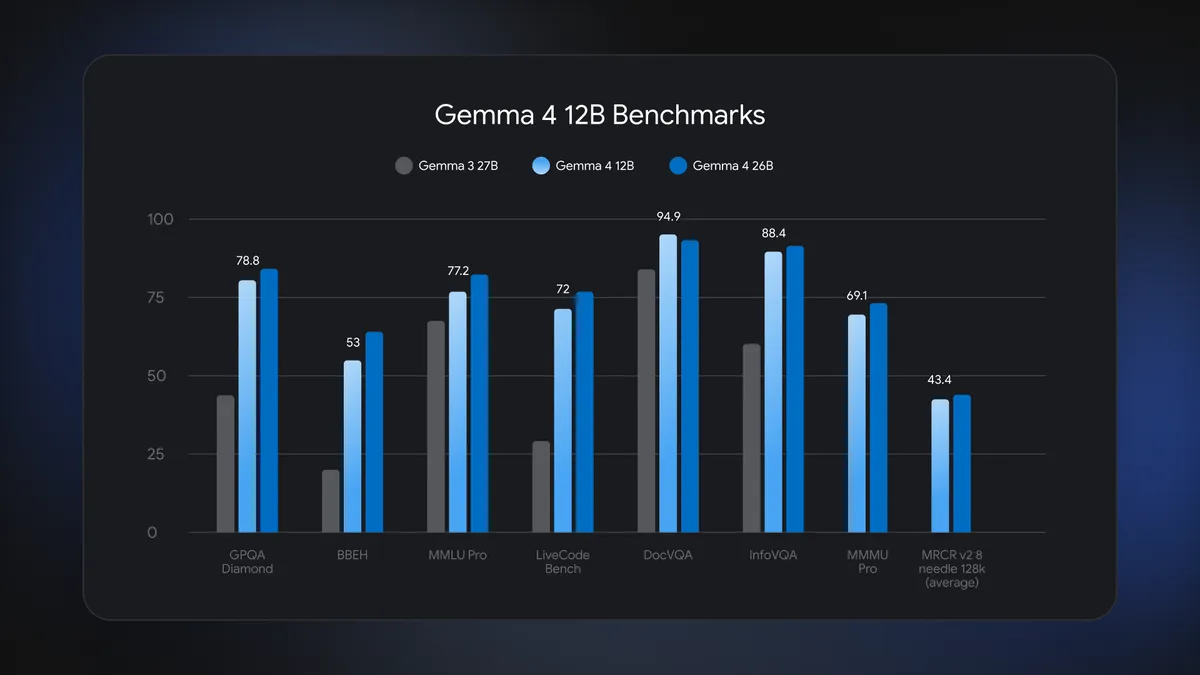
Gemma 4 12B delivers performance nearing our larger 26B MoE model on standard benchmarks, but at less than half the total memory footprint. Small enough to run locally on consumer laptops with 16GB of RAM, it unlocks powerful multimodal and agentic experiences right on your machine.
Experience a uniquely efficient, unified architecture
What makes Gemma 4 12B stand out is its streamlined approach to processing visual and audio inputs. Traditional multimodal models typically rely on separate encoders to translate images and audio before passing those representations to the language model. Because these split encoders add latency and increase memory usage, we trained Gemma 4 12B with an encoder-free architecture to integrate audio and vision input directly.
Here is how Gemma 4 12B processes multimodal inputs natively:
- Vision: We replaced Gemma 4’s vision encoder with a lightweight embedding module consisting of a single matrix multiplication, positional embedding and normalizations. This allows the LLM backbone to take over visual processing.
- Audio: We simplified audio processing even further. We removed the audio encoder entirely and projected the raw audio signal into the same dimensional space as text tokens.
For developers who want a breakdown, head over to our companion Gemma 4 12B Developer Guide .
Get started today
- Try it yourself : Experiment with a couple of clicks in LM Studio , Ollama , Google AI Edge Gallery App , the Google AI Edge Eloquent app and the LiteRT-LM CLI
- Download the weights : Download the pre-trained and instruction-tuned checkpoints directly from Hugging Face and Kaggle .
- Integrate & learn: Review the developer documentation and the quick start notebook .
- Use your favorite development tools : Implement local inference pipelines with Hugging Face Transformers , llama.cpp , MLX , SGLang , and vLLM , or fine-tune with efficiency using Unsloth .
- Unlock Agentic Development with Gemma Skills: To support agents to build with the latest Gemma advancements, we are releasing our official Skills Repository . This is a library of skills designed specifically to enable agents to build with Gemma models.
- Deploy your way: Spin up endpoints in production using Google Cloud. Deploy your way through Gemini Enterprise Agent Platform Model Garden , Cloud Run and GKE .