AI 智能体开始自己付钱了:AWS 上线 AgentCore payments,用 x402 处理 HTTP 402 的按需支付、托管钱包签名、并把支出上限放在基础设施层强制执行——客户 Incarna 借此按单次请求向 BlockRun 买推理,接入工作从数月缩到数天
Pay-per-inference for AI agents: How BlockRun and Incarna use Amazon Bedrock AgentCore payments
精选评分 60
导读
AWS 发布 Amazon Bedrock AgentCore payments,一种给智能体加入支付能力的托管功能。文章先说明问题形态:智能体在执行任务时常常需要买点什么才能完成——一次模型推理、一个 API 响应、访问网页内容,或调用另一个智能体;这些支付金额极小、频率极高(单笔可能只有几美分的一部分),而且发生在智能体的循环内部、当时没有人在场可以批准。卡组织本就不是为不足一美分的支付而建,自建支付通路则要同时解决资金存放在哪、每笔支付如何签名、如何支持 x402 这类新兴支付协议,以及如何让自主智能体不超支。AgentCore payments 把这几件事一次托管:它处理支付协议、连接钱包、签署交易并强制执行支出上限。文中给出的真实用例是 Incarna 用它按单次请求向 BlockRun 购买模型推理——BlockRun 是一个按用付费的推理路由,经 x402 提供来自 15 家以上供应商的 90 多个模型,每次调用单独报价与结算;该服务与支持 x402 的端点互通,其中也包括 Amazon Bedrock 的推理端点。几处设计要点值得注意:钱包由客户持有(Incarna 用 Coinbase CDP 连接器为每个智能体开设钱包,客户授予其委托授权);当被收费的端点返回 HTTP 402(需要支付),智能体经该服务用 x402 完成支付、用配置好的钱包签名并向商家回传密码学凭证;支出治理被放在模型之外的基础设施层,因此即便提示被操纵,智能体也无法越过限额;结算走稳定币(Incarna 用 Base 网络上的 USDC,每笔链上可验)。落地效果是公司把加 x402 支付支持的工作量从数月降到数天,并把按次推理支付的端到端流程投入生产。
推荐理由
把「智能体自己花钱」这件事的工程难点(资金存放、签名、x402、防超支)一次给出托管解,并用「数月降到数天」与客户名给出可用性证据,是 agent 经济基础设施的具体一步。
主体与标签
Amazon#产品更新#Agent#定价/成本
正文
When an AI agent runs, it often needs to buy something to finish a task: a model inference, an API response, access web content, or a call to another agent. These purchases are small and frequent, sometimes a fraction of a cent each, and they happen inside the agent’s loop with no person available to approve them.
Amazon Bedrock AgentCore payments removes that burden. It gives agents a managed way to pay for services on demand, with spending limits enforced by the infrastructure rather than by the model. In this post, we look at how Incarna used AgentCore payments to let its agents pay BlockRun for model inference one request at a time. BlockRun is a pay-as-you-go inference router serving more than 90 models from more than 15 providers over x402 , each call quoted and settled independently. AgentCore payments works with x402-compatible endpoints, including Amazon Bedrock inference endpoints. With the service, the Incarna team cut the work of adding x402 payment support from months to days, and put an end-to-end pay-per-inference flow into production.
The challenge: Paying for inference by the request
Paying per inference is a high-frequency, low-value pattern. An agent might make hundreds of small purchases in a single session, each worth a fraction of a cent. Card networks weren’t built for sub-cent payments. Building your own rails means solving several hard problems at once. You must decide where the money is held and how each payment is signed, support emerging payment protocols such as x402, and keep an autonomous agent from overspending.
What AgentCore payments provides
Amazon Bedrock AgentCore is a platform to build, connect, and optimize agents at scale, with any framework or model. AgentCore payments is a managed capability of Amazon Bedrock AgentCore that builders can use to add payments to their agents in a few lines of code. It handles the payment protocol, connects to a wallet, signs the transaction, and enforces spending limits. Builders integrate through one managed service instead of assembling the parts on their own. A few things make it a good fit for pay-per-inference:
- Managed wallets. Incarna provisions each agent’s wallet using the Coinbase CDP connector. The customer owns it and grants Incarna a delegated authorization to use the wallet.
- Native protocol handling. When a paid endpoint answers with HTTP 402 (“Payment Required”), the agent uses AgentCore payments to make the payment over x402. It signs the transaction with the configured wallet and returns cryptographic proof to the merchant.
- Spending governance at the infrastructure layer. AgentCore payments enforces limits outside the model, so an agent can’t exceed them even if its prompt is manipulated.
- Settlement you can audit. Payments settle in a stablecoin. Incarna uses USDC on the Base network, and each transaction is verifiable on-chain.
The following diagram illustrates the end-to-end architecture. AgentCore runs the agent, BlockRun serves metered inference, and AgentCore payments connects to the customer’s wallet, enforces the spending limit, and signs each payment on behalf of the agent’s Incarna identity.
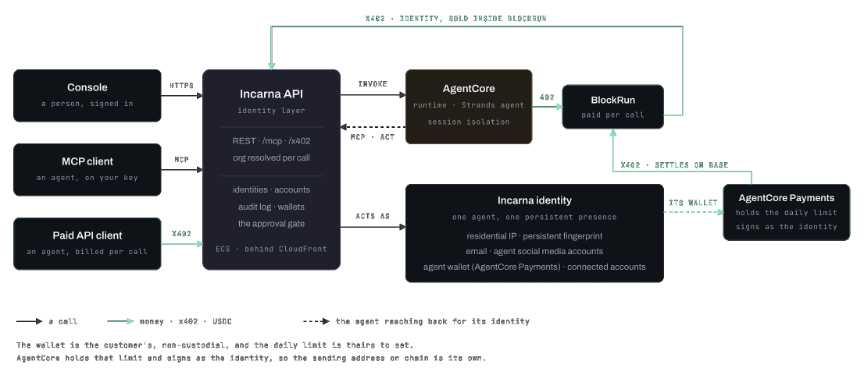
Figure 1: Pay-per-inference architecture. Agent request flows through AgentCore to BlockRun (HTTP 402), with AgentCore payments signing the x402 payment from the agent’s own wallet
Source: incarna.io/aws-blockrun-incarna-partnership
Prerequisites
The path Incarna followed is open to other teams, and AgentCore payments provisions the pieces for you. You can set them up through a guided conversation with the AgentCore payments skill in the Agent Toolkit for AWS (in Claude Code, Kiro, or Codex). You can also create each one yourself with the AgentCore CLI, the AgentCore SDK, or the AWS SDK.
Start by storing your Coinbase CDP or Stripe Privy credentials as a payment credential provider, which keeps the secrets in AWS Secrets Manager instead of your code. Create a Payment Manager and connector to coordinate payments against those credentials, and set a default spending limit while you’re there. Then create a payment instrument, the embedded wallet the agent pays from. The end user funds it and grants signing permission through a redirect URL, and on a test network you can fund it with testnet USDC.
The flow: Buying and selling one inference
In this integration, BlockRun is the seller. BlockRun serves metered model inference from a live catalog, and each call is quoted, paid, and settled on its own. The flow for a single inference is straightforward:
- The agent needs a model call. It integrates with BlockRun, which handles provider selection and delivery. No per-provider subscription required.
- BlockRun answers with PaymentRequired challenge and a price for that specific call.
- It opens a payment session and calls ProcessPayment . AgentCore payments checks the quote against the spending limits set for the session and signs the authorization from the agent’s own wallet address.
- The seller verifies the payment signature.
- BlockRun serves the inference and records the charge, a small per-call amount.
Because settlement happens per request, the agent pays only for what it uses, and a call the agent chooses not to make costs nothing.
AgentCore payments supports two x402 payment schemes: exact and upto . The exact scheme is usually used when the price is known up front. The upto scheme suits resources with dynamic pricing. The agent authorizes a ceiling amount, and the inference provider settles for actual usage at the end, up to that ceiling.
Keeping spend under control
The piece that makes builders comfortable letting an agent move real money is the payment session. A session sets a ceiling, the most the agent can spend, and AgentCore payments enforces that ceiling at the infrastructure layer. The agent’s own code and prompt can’t change it. Each session also carries an expiry time, and Incarna sizes its sessions to a day’s budget. If something goes wrong in the agent’s logic, it still can’t spend past the limit the customer set. Even integrations that don’t use session-level budgets today can adopt it without code changes. For more on how these controls work, see Enable safe agentic payments with built-in guardrails .
Results
Incarna put the pay-per-inference flow into production on Base, with BlockRun serving the sell side and AgentCore payments governing every transaction.
“The next generation of AI agents shouldn’t have to choose between better performance and sustainable economics. BlockRun’s open source router gives developers full control over their own model set, while continuously benefiting from BlockRun’s ongoing benchmark-driven routing improvements—delivering higher task success rates at lower token cost. And with AgentCore payments and x402 providing the spending controls agents need, that intelligence can be put to work safely in the real world.” — Vicky Fu, Founder, BlockRun
The Incarna team completed the full AgentCore payments integration in three days: one to build and two to test. That was roughly 200 lines of application code, against the two to three months originally scoped. Across the beta, agents have processed over 1,000 payments ranging from $0.001 to $0.05 per call, each settling individually on-chain.
“AgentCore payments covered everything we needed for an agent to pay over x402: a wallet the customer owns, a funding and revocation flow, a spending limit the platform enforces, and signing that handles both versions of x402. We wrote none of it.” — Justin Zhou, Founder, Incarna
Conclusion
AgentCore payments gives agents a governed, on-demand way to pay for the services they use. BlockRun and Incarna show how it comes together end to end: an agent that pays for inference, a provider that meters and settles it, and an identity that owns the transaction. If you’re building agents that need to buy services as they run, you can add that capability through a single, governed integration point with AgentCore payments.
Getting started
Ready to add pay-per-inference to your agents? Here’s how to start:
- Set up AgentCore payments. Create a Payment Manager with your wallet connection and spending policies. Connect a Coinbase CDP wallet as your credential provider. See the AgentCore payments developer guide for step-by-step instructions.
- Open a payment session with your budget. Before the agent starts a task, open a session with a spending cap that fits the workload. The agent transacts within that ceiling and the infrastructure enforces it.
- Call a paid endpoint. Point your agent at an x402-compatible service (like BlockRun). When the endpoint returns HTTP 402, call ProcessPayment with the payment details. AgentCore payments handles the signing and returns proof the agent can present to access the service.
To explore the code, see the AgentCore payments samples on GitHub .
Learn more
- Amazon Bedrock AgentCore payments is now generally available: Enabling agents to transact safely and autonomously at scale
- Technical deep dive: AgentCore payments and innovation in agentic commerce
- Enable safe agentic payments with built-in guardrails using AgentCore payments
About BlockRun and Incarna
BlockRun is a pay-as-you-go inference router that serves model inference over the x402 payment protocol. Agents reach a live catalog of models through a single metered endpoint. Each call is independently quoted, authorized, paid, and settled on Base (USDC). BlockRun handles provider selection and delivery so agents access many models through one integration without per-provider subscriptions or billing relationships.
Incarna , built by SpreadX, gives AI agents a persistent identity that survives sessions, models, and runtimes. Each identity carries its own wallet, email address, social accounts, and an action history that stays attached to one ID across runs. When an agent pays for a service, the on-chain payer is the agent’s own identity rather than a shared platform key, making every transaction attributable to a single durable entity. Incarna is live on Base mainnet with real settlement.
About the authors

Peter Jiang
Peter is a Senior Software Developer at AWS, based in Seattle, WA. He is a core member of the engineering team behind the Amazon Bedrock AgentCore payments initiative, which enables AI agents with payments capability. With over 8 years of experience in the financial and payments industry, Peter has launched multiple greenfield projects spanning banking, crypto, and agentic systems. Previously, he worked on ultra-low-latency trading systems at Susquehanna International Group.

Guy Bachar
Guy is a Senior Solutions Architect at AWS, working with fintech and capital markets firms on agentic AI, autonomous commerce, and cloud transformation. He focuses on building systems where AI agents act on behalf of customers across payments, customer experience, and governance.

Chethan Shriyan
Chethan is a Principal Product Manager, Technical at AWS, based in Seattle, WA. He brings nearly 13 years of experience in product and business management, including over 7 years at Amazon. He is passionate about building and delivering technology products that create meaningful impact in customers’ lives.