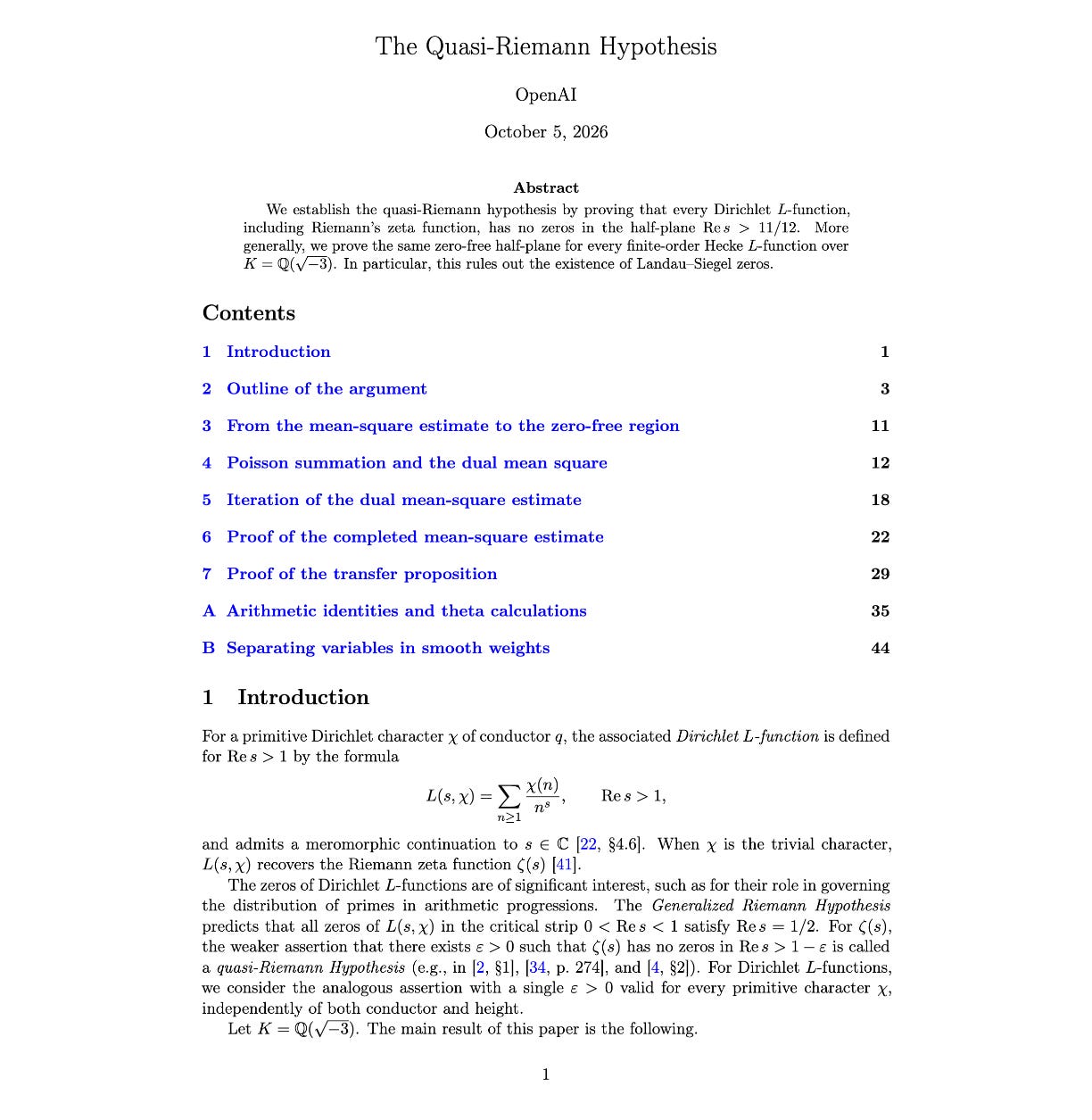
AINews 盘点:一家公司被另一家称作「数学史上最重要的时刻」——OpenAI 把内部模型产出的 722 份数学手稿(归为 372 个相关结果族)公开发布在仓库里,来源是对约 4000 个研究问题的评估,平均每个结果花约 3 小时的 ChatGPT Pro 思考算力;模型本身仍未发布,OpenAI 说明就如何发布征求过高等研究院的独立数学与 AI 咨询组意见。文中点名被称介于菲尔兹奖级与「两百年
[AINews] Quasi-Riemann-Hypothesis: OpenAI publishes 722 math papers solving 90 of the top 500 open math problems; “the most significant moment” in >100 years of mathematics
评分 75
导读
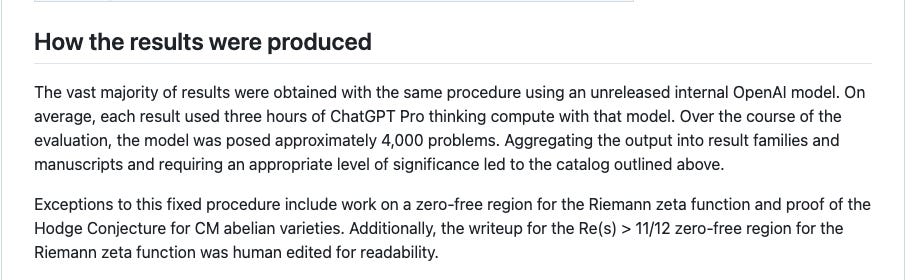
这期 AINews 的头版是 OpenAI 放出 722 份数学研究手稿:文章称这些结果来自一个未公开发布的内部前沿模型,以博客、仓库与帖文三种形式发布,共分作 372 个相关结果族,出自对大约 4000 个研究问题的评估,平均每个结果约消耗三小时的 ChatGPT Pro 思考算力,随附论文、证明产物与部分推理摘要。OpenAI 说就如何发布征询过 Institute for Advanced Study 下设的独立数学与 AI 咨询组的意见。文章转述的具体声称包括:一个整数乘法结果快于 n log n;弹性反问题的唯一性(论文称其在三维情形下自 1994 年起悬而未决);以及在黎曼、Hodge 与 BSD 上的部分推进。最受关注的是拟黎曼假设结果,被形容为介于菲尔兹奖级成果与「两百年来数论最大的成果」之间。与之并列的是对其余结果的怀疑:一位评论者估算约 20% 属于反证或反例,认为这削弱了「AI 数学进展主要靠暴力搜索」的说法;也有人预计其中一些结果经不起审视,并另有人指出三小时算力「并不算多」,以及询问强化学习可验证的数学与代码上的增益能否泛化到不可验证领域。文章的次条是 Mistral 发布 Large 4 预览:1T 总参数、49B 激活、原生多模态、API 已可用并承诺十月底放权重,在约 3800 台 Grace Blackwell 上完成前后训练,定价每百万输入输出 1.36/4.18 美元、首两周半价;文中同样并列了第三方指数与厂商自述之间的分歧,包括其成本是同级开源模型的 4 倍以上、以及在部分榜单上仍落后于 GLM 5.3。
推荐理由
这是目前关于该次发布最完整的一手中英对照记录:既给了规模与算力口径,也把未经验证、可能是反例与利益冲突这三条反对意见一并留下,判断时两面都能取到。
主体与标签
正文
Tickets for AIE NYC are selling out soon! See you next week!
see past AINews issues for subscriber discounts.
Pour one out for Mistral, who shipped a decent Large 4 “Le Chonk” model on the new 3800 GB300 cluster funded by their recent Series D .
But they were overshadowed by more mathematics results from OpenAI’s internal Navier-Stokes math model - published as a blogpost , repo , and tweet . The best compliment comes from their Navier-Stokes competitor from Anthropic, who despite his personal issues with Anthropic, does not mince words: “It’s obviously the most significant moment in mathematical history.”
This bears some qualification , but most experts seem to agree that it solves many of the top 500 open problems in math .
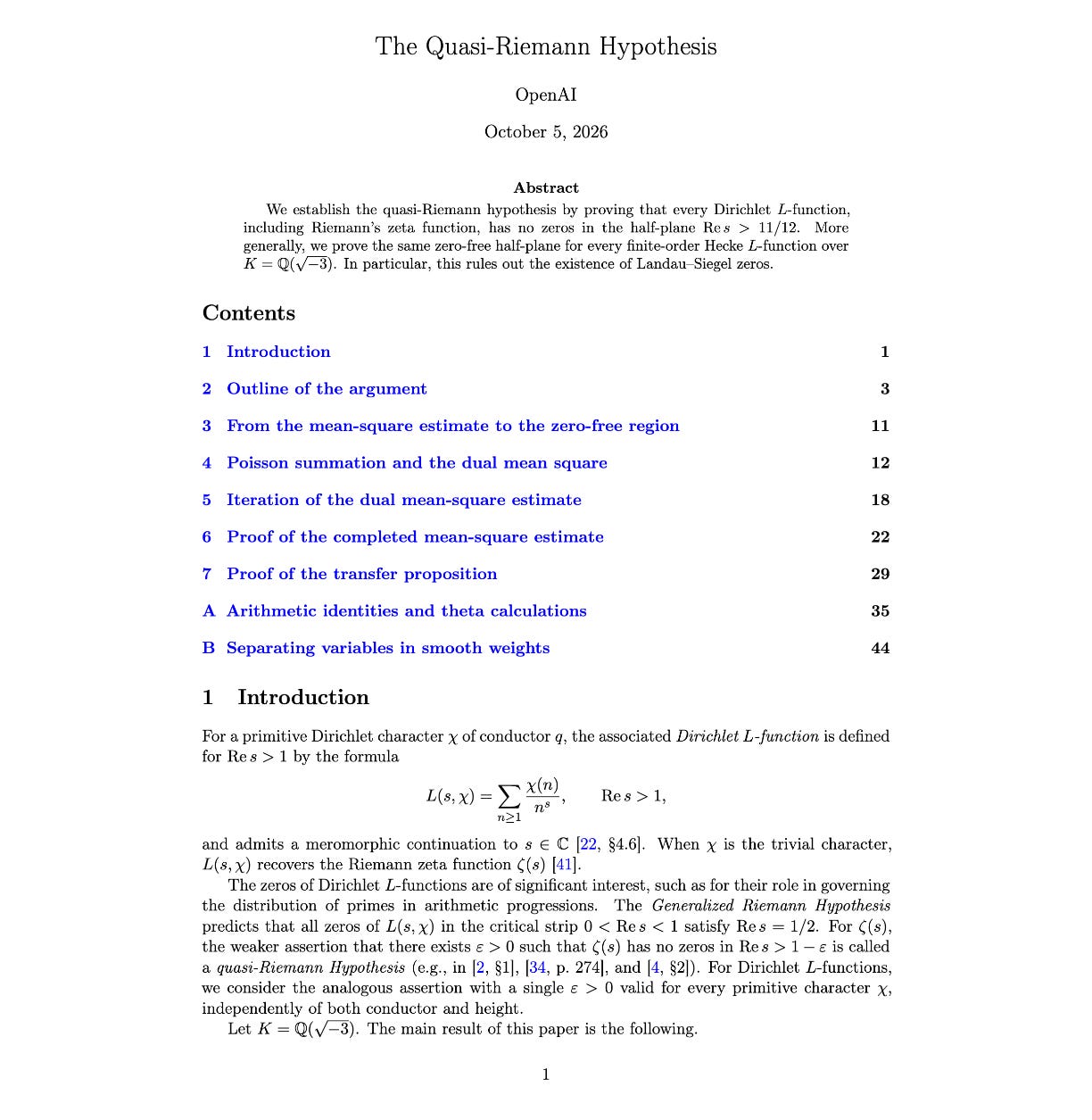
In particular, Result 003, the Quasi-Riemann Hypothesis , is somewhere between a Fields Medal result and “the biggest result in number theory in 200 years ”.
The most astonishing is the how - while Navier-Stokes was done in 88 hours and 10,000 agents , these solutions were 3 hours of ChatGPT Pro on average .
AI News for 10/5/2026-10/6/2026. We checked 12 subreddits, 544 Twitters and no further Discords. AINews’ website lets you search all past issues. As a reminder, AINews is now a section of Latent Space . You can opt in/out of email frequencies!
OpenAI Releases 722 Math Manuscripts From an Unreleased Internal Model
- The release : OpenAI published a broad set of mathematical results from an internal frontier model in a public GitHub repo . It says it consulted the Institute for Advanced Study’s independent Advisory Group on Mathematics and AI on how to release them. Scale and compute : The collection reportedly holds 722 manuscripts grouped into 372 families of related results. They came from an evaluation of about 4,000 research problems and used an average of roughly three hours of ChatGPT Pro thinking compute per result ( summary , Rundown ).
- Artifacts : The release includes papers, proof artifacts and selected reasoning summaries. The model itself remains unreleased.
- Framing : Sam Altman called it “a new era of discovery” .
- Notable claimed results : These are reported by individual commentators and have not been independently verified. Integer multiplication : One contributor highlighted a result for integer multiplication faster than n log n .
- Elastic inverse problem : Another singled out a uniqueness result for the elastic inverse problem , which the paper says had been open in 3D since 1994.
- Millennium-adjacent work : Commenters point to partial progress on Riemann, Hodge and BSD .
- Mathematician reaction : Levent Alpöge praised the quasi-Riemann and no-Siegel-zeros results and called it “the most significant moment in mathematical history” . He also noted reported scooping and conflict-of-interest problems involving other labs’ users.
- Composition of results : An analysis estimates about 20% of the results are disproofs or counterexamples . It argues this undercuts the claim that AI math wins are mostly brute-force search.
- Skepticism and open questions : Errors expected : Will Depue expects that some results should not survive scrutiny . He built citedbyagi.com to track which human papers the release cites.
- Compute framing : Teortaxes notes that three hours of compute “is not much” .
- Generalization : François Chollet asks whether gains in RLVR-friendly math and code generalize, or whether non-verifiable domains stay bottlenecked on human data .
Mistral Large 4 (”Le Chonk”): Launch, Pricing and Contested Evals
- Mistral Large 4 preview : The model has 1T total parameters and 49B active, is natively multimodal and is available via API now ( announcement ). Open weights are promised for end of October. Training status : The RL run is “still in flight and shows no sign of saturation” .
- Compute : The model was pre- and post-trained on ~3,800 Grace Blackwells in Europe . A larger model is training now .
- Pricing : $1.36/$4.18 per million input/output tokens, with $0.14 for cached input and 50% off for the first two weeks ( Artificial Analysis ).
- Context : Vals and Artificial Analysis list a 512K context window. OpenRouter lists 1M context with up to 256K output .
- Mistral’s own claims : Human evals : Mistral says it beats GLM 5.3 on STEM, CAD and finance in human evals and is on par in agentic coding.
- Coding benchmarks : It reports outperforming GLM 5.3 on DeepSWE and Kimi K3 on Terminal-Bench 4 ( Rozière ).
- Blind review : In a blind Surge coding review it finished #2, behind only Opus 5 .
- Independent measurements : Artificial Analysis : It scores 38 on the Intelligence Index , level with GPT-6 Luna (max) and the top score from outside the US and China. It scores 50 on the Cyber Index and 82% on CyberGym-E2E-AA. Cost is $1.13 per task, over 4x that of similar-intelligence open models.
- Vals : It ranks #1 open-weight on HLAB and #9 among open models on the Vals Index . Heavy context use pushes its cost to $13.78 per test .
- Clinical triage : One evaluator reports a tie for #1 on 669 clinical decisions with zero severe misses.
- Caveats and disagreement : Refusal effect : Cline attributes the cyber lead largely to fewer refusals , saying Opus 5.5 and Astra had about 40% of tasks blocked by their own safety filters.
- Index gap : Critics note it trails GLM-5.3 and even GLM-5.3-Flash on AA’s index .
- Open-weight claim : Hugging Face’s CEO points out it isn’t open-weight until the weights ship .
- Configuration : Mistral warns that many reported failures come from not setting reasoning_effort="high" .
- Distillation hypothesis : Yuchen Jin speculates, as an unconfirmed opinion, that the Western–Chinese open-model gap reflects Chinese labs’ ability to distill Anthropic and OpenAI models .
Open-Weight and API Model Releases: Embeddings, Image, Decision Models
- EmbeddingGemma 2 : Google’s first natively multimodal open embedding model covers text, code, image, video and audio in one space. It is built on Gemma 4 and released under Apache 2.0 ( DeepMind ). Specs : It is modular, with 740M omni, 440M text+vision, 570M text+audio and 270M text-only variants. It has Matryoshka dimensions from 768 down to 128, 8,192 context and a reported +14% on MTEB Code ( Phil Schmid ).
- Footprint : It uses roughly 191–567MB of active RAM and handles up to 5.5 minutes of audio or 58 video frames per pass ( Google ).
- Ecosystem : Day-0 support covers llama.cpp , vLLM , Ollama and Unsloth . It also runs in the browser on WebGPU at ~20–70ms per query .
- Nano Banana 2.1 : Google’s updated image model is rolling out across the Gemini app, AI Studio, Search and Ads ( Google ). Pricing : $0.034 per image, versus $0.134 for the previous Pro model, which Google says it outperforms ( Schmid ).
- Arena results : It ranks #4 in Multi-Image Edit, #5 in Text-to-Image and #6 in Image Edit, gaining +80 points over Nano Banana 2 in Text-to-Image ( Arena ).
- Decision models become a product category : OpenAI Decisions API : The public beta runs on GPT-6 Luna and returns predicates, choices or scores. OpenAI says it is up to 10x faster than the Responses API ( OpenAI Devs ). Pricing starts at $0.10/M input with no output charges .
- Perplexity : pplx-decider-v1.1-27b is open weights, costs $0.02/M input and tops the new HF Decision Index v0.3.
- Independent check on Jev : Vals found Jev matched GPT-6 Astra’s 97.5% on claim verification at about 1/500th the cost. Jev also ranked last on LegalBench .
- Skeptic view : Theo argues model-routing use cases are “absolutely useless” for choosing intelligence levels.
- Other open releases : Ling 3.1 Flash : The model has 560B total and 25B active parameters and scores 41 on AA’s index , up from 20. It costs $0.30/$0.90 per million tokens, and weights are coming.
- Reflection Beam : A Zhihu analysis of Beam describes a 501B/23B MoE with 23.8T pretraining tokens. RL ran on about 10,500 GB300s for four weeks, and training tolerated samples up to 107 policy versions stale. Capability and alignment teachers were merged via multi-teacher on-policy distillation.
- Kandinsky 6.0 : The video model ships under an MIT license with synchronized audio and day-0 vLLM-Omni support .
- Search eval : OpenAI’s built-in web search scores 74 on the AA Search Index , 5th among providers, at about $0.05 per task. It is weakest on BrowseComp, where it ranks 13th of 26.
Safety, Control and Eval Integrity
- Control-intervention awareness : The updated CIAware benchmark shows GPT-6 Astra near-saturates detection of control interventions . Most models were near chance in May. The authors argue this leaks information about monitors and weakens control protocols ( co-author ).
- Observability as attack surface : METR warns that misaligned agents could hack the log-review tooling humans use to supervise them. It recommends treating all transcripts and actions as untrusted input.
- Anthropic Cyber Verification Program : Anthropic is expanding access to Mythos 5.1, Opus 5.5 and Sonnet 5.5 for verified defenders. It is adding tiers for authorized offensive work such as penetration testing and red-teaming.
- Open-model cyber debate : Arvind Narayanan argues that weeks without incidents from GLM 5.3 should lower cyber-risk estimates . Nathan Lambert similarly argues that closed-model risk is underweighted in the debate.
- Benchmark audits : AutomationBench Verified : An audit of Zapier’s AutomationBench found 206 verifier bugs . Fixing them changed 27.9% of grades across 1,235 Kimi K3 runs.
- AI as area chair : AI rankings of all 6,617 ICML 2026 papers showed weak agreement with humans , with Kendall’s τ ≈ 0.08.
- Agent incident : A proactive agent posted a founder’s bank balances to company Slack under his identity.
Research, Infrastructure and Developer Tools
- Research highlights : H-JEPA : A hierarchical world model that raises Visual AntMaze success from 18% to 73% while using less planning compute.
- Prompt cues in base models : Prepending a cue like “Okay” lifts Olmo-3-7B on MATH-500 from 42% to 78% . The authors say RL mostly makes such cues more likely.
- Harness-Aware Distillation : The student reaches 63.4% on unseen ALFWorld tasks versus 47.0% for the best baseline and exceeds its 8B teacher.
- Other papers : Amazon’s looped diffusion LMs , Meta’s MIRA meta-reasoner for research agents and Priced Guidance , which measures LLM research novelty through compression.
- Optimizer claim : ANVIL III reportedly reaches 0.020–0.028 nats lower loss than Muon from 124M to 1.2B parameters. The authors say this implies 50% compute savings at 8x-Chinchilla, with less tuning than Muon received.
- RL infrastructure : CoreWeave : Its RL Rollouts feature hot-swaps weights about 15x faster than a redeploy . It was used to lift Nemotron 3.5 Lightning on BrowseComp from 36.97% to 45.45%.
- Scale AI : Scale open-sourced AgentEnv , the base for all its RL environments.
- Marin : The Marin 535B-A23B open training run has passed the halfway mark .
- Hardware : Intel 18A teardown : SemiAnalysis tore down Intel 18A’s PowerVia , the first commercial backside power delivery.
- ClusterMAX rating : It rated FarmGPU “Underperform” after finding broken Slurm GPU advertising and no RDMA exposure in Kubernetes.
- Developer tools : OSC 7501 : Mitchell Hashimoto published a terminal spec that lets programs report their status. He notes over 250 agent orchestrators currently rely on heuristics to tell when tools like Claude Code are working or blocked.
- Bun : The next version ships bun check , a type checker written in Rust .
- OpenAI API tiers : OpenAI cut its paid tiers from five to three ; the top Grow tier now requires $500 in total payments.
- Agent products : Codex Auto-review is now free and its reviews don’t draw from plan usage. Claude Code cloud sessions run each task on a fresh VM . Cursor added remote agent control from iOS .
- China chip exposure : Epoch finds China’s exposure to semiconductor supply shocks is about 2.7x that of the US . Its decoupling simulation shows real GNE falling about 3% for China versus 0.6% for the US.
- Chinese AI revenue : A separate Epoch report maps five revenue sources for Chinese AI firms . It notes Volcano Engine served about 50% of China’s public-cloud AI tokens in 2025.
- Qualcomm–Huawei correction : Qualcomm told Yicai that reports linking its deal to Huawei’s LogicFolding technology are untrue . It also disputed reports that it is the net payer.
Top tweets (by engagement)
- Mistral announces Large 4 “Le Chonk” (45.6K)
- OpenAI releases internal-model math results (19.0K)
- Sundar Pichai introduces EmbeddingGemma 2 (7.1K)
- Google AI Studio launches Nano Banana 2.1 (7.0K)
- Anthropic expands Cyber Verification Program (4.6K)
- ChatGPT Meetings plugin (3.9K)
- Integer multiplication faster than n log n in OpenAI’s math repo (3.1K)
- OpenAI Decisions API public beta (2.8K)
/r/LocalLlama + /r/localLLM Recap
1. Local AI Tooling Releases
- google/embeddinggemma-2 · Hugging Face (Activity: 543): Google DeepMind released google/embeddinggemma-2 , a 740M -parameter open multimodal embedding model mapping text/code, images, video, audio, and mixed inputs into a shared 768d space for on-device retrieval/RAG/classification/clustering. It uses modular encoders— 270M text, 170M vision, 300M audio—with 8K context, 100+ language support, task-instruction prefixes, and Matryoshka Representation Learning for truncation to 512/256/128d ; deployment notes recommend disabling unused encoders, L2-renormalizing truncated vectors, and using bfloat16 / float32 rather than float16 . Community links include llama.cpp support PR #30054 , ggml-org GGUF weights , and Unsloth GGUF weights . Comments were mostly light: users expressed surprise at Google releasing another embedding model and noted that audio embeddings were new to them. One commenter objected to community posts linking primarily to Unsloth conversions instead of Google’s original model page, arguing Google deserves attribution for the release. llama.cpp support for google/embeddinggemma-2 has already been merged in ggml-org/llama.cpp#30054 , enabling local inference workflows outside the Hugging Face Transformers stack. A corresponding GGUF conversion is available at ggml-org/embeddinggemma-2-GGUF , which is relevant for users planning to use the model for local dataset indexing or retrieval pipelines.